83%
of hires fail due to rushed or passive recruiting.
Top rated specialist

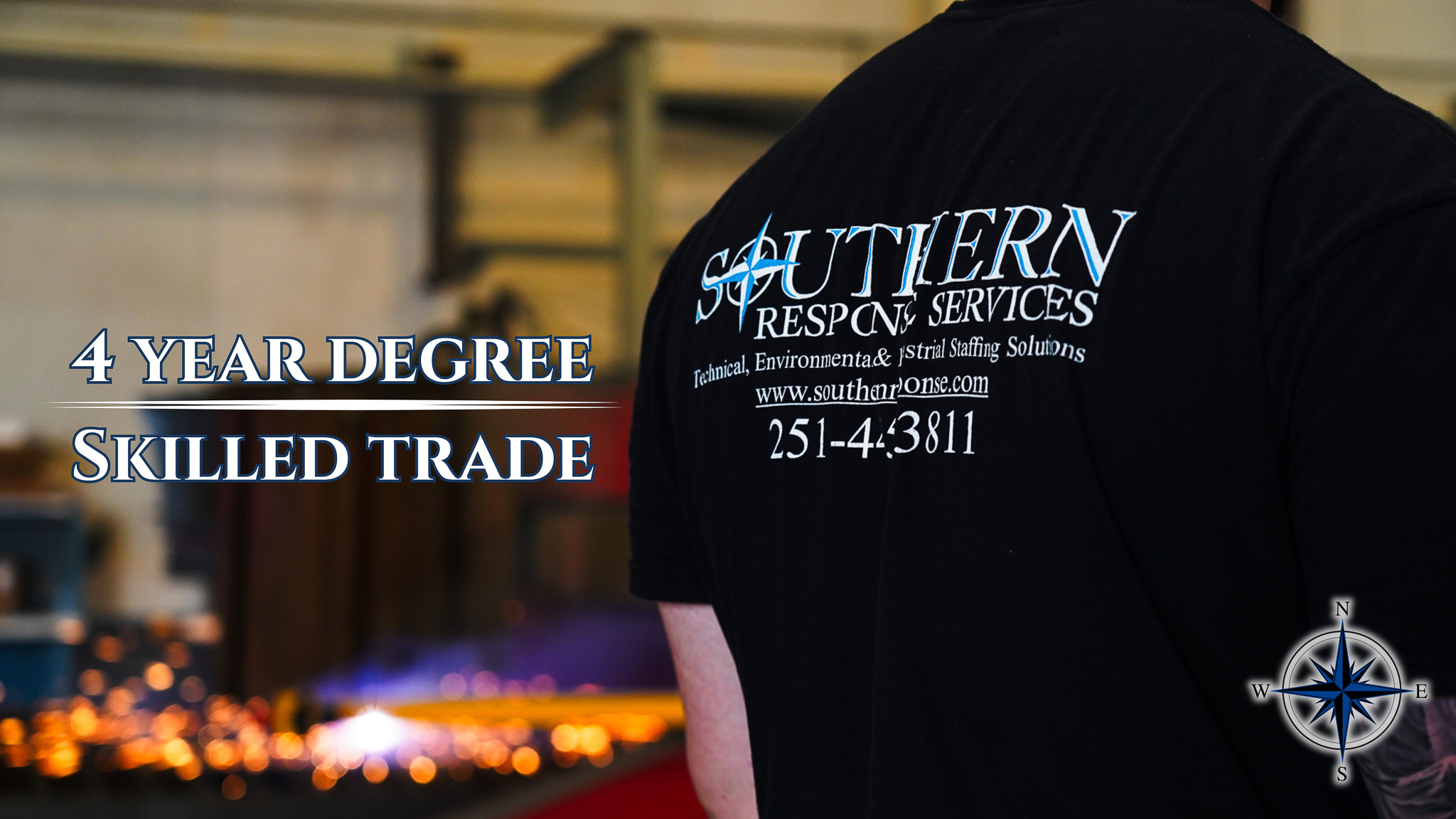
For generations, many young people were given the same advice:
Graduate high school. Go to college. Earn a degree. Find a career.
For some people, that path is exactly the right one.
But it isn't the only path to a successful career.
Across America's industrial workforce, welders, electricians, machinists, mechanics, operators, technicians, pipefitters, and countless other skilled professionals are building careers without following the traditional four-year college route.
These men and women aren't taking a backup option.
They're building the infrastructure, facilities, ships, equipment, manufacturing operations, and industries that keep America moving.
At Southern Response Services, we believe skilled trades deserve to be recognized for what they truly are:
Careers with opportunity, purpose, and room to grow.
There is nothing wrong with earning a college degree.
The problem comes when young people are led to believe that a degree is the only respectable path toward a successful future.
It isn't.
Success can look different for everyone.
For one person, it may mean becoming an engineer.
For another, it may mean becoming a highly skilled welder.
Someone else may become an industrial electrician, CNC machinist, heavy equipment operator, maintenance technician, or supervisor.
All of those careers require knowledge.
All require skill.
And all can play an important role in the industrial workforce.
The question young people should be asking isn't simply, "Where should I go to college?"
It should be:
"What kind of career fits the life I want to build?"
One misconception about industrial work is that skilled trades are simply physical jobs.
Anyone who has worked in these industries knows better.
Consider an experienced industrial electrician troubleshooting a complicated electrical system.
A machinist operating precision equipment.
A welder performing work that must meet strict specifications.
A mechanic diagnosing a problem that could shut down an entire operation.
These jobs require technical knowledge, attention to detail, problem-solving ability, experience, and continuous learning.
The best tradespeople spend years developing their craft.
Their knowledge becomes valuable because it can't always be learned from a textbook.
Some lessons are learned through experience.
There is something powerful about finishing a day's work and being able to see what you accomplished.
A structure was built.
Equipment was repaired.
A production line stayed operational.
A ship moved closer to completion.
A facility continued running.
A project reached another milestone.
Industrial workers have the opportunity to physically contribute to something larger than themselves.
For people who enjoy working with their hands, solving practical problems, operating equipment, or seeing tangible results from their work, the skilled trades can offer something a traditional office environment may never provide.
Starting in the trades doesn't mean doing the same job forever.
Industrial careers can lead in many directions.
A helper can become a journeyman.
A technician can become a lead technician.
A welder can become a supervisor.
An operator can move into management.
An experienced tradesperson may eventually become a superintendent, project manager, estimator, instructor, inspector, or business owner.
Experience creates options.
And many of the strongest leaders in industrial companies started their careers exactly where the work happens:
In the field.
They understand the employees they lead because they've done the job themselves.
Education is valuable.
But education doesn't only happen on a college campus.
Trade schools, apprenticeships, certification programs, employer training, mentorship, and hands-on experience can all provide valuable pathways into industrial careers.
For someone who learns best by doing, this can be a completely different experience from sitting in a classroom for four years.
You can learn a skill.
Apply it.
Develop experience.
Continue improving.
And build a reputation around the quality of your work.
In the industrial world, what you can do matters.
Technical skills are important, but some of the most valuable qualities in any workplace are surprisingly simple.
Show up.
Be on time.
Be willing to learn.
Work safely.
Listen to experienced employees.
Take pride in your work.
Be someone your crew can depend on.
Those habits may sound basic, but consistently demonstrating them can separate an average employee from someone supervisors want to keep around.
You don't have to know everything on your first day.
You do need to be willing to learn.
Experienced tradespeople have built incredible careers across the industrial world.
But those skills have to be passed down.
The next generation of workers will eventually become the welders, electricians, operators, technicians, supervisors, and leaders responsible for keeping those industries moving.
That creates an opportunity for young workers who are willing to learn a trade and take their careers seriously.
Industrial careers aren't disappearing.
The tools may change.
Technology may improve.
Facilities may become more advanced.
But skilled people will still be needed to build, operate, repair, maintain, and improve them.
There should be pride in knowing how to do something well.
There should be pride in becoming the person others call when there's a difficult problem.
There should be pride in mastering a trade.
And there should be pride in knowing that your work contributes to industries and communities across the country.
A successful career doesn't have to come with a suit, an office, or a four-year degree hanging on the wall.
Sometimes success wears steel-toe boots.
At Southern Response Services, we connect workers with opportunities across industrial, technical, marine, environmental, and skilled-trade environments.
Whether you're an experienced tradesperson looking for your next opportunity or someone beginning to explore what a career in the industrial world could look like, your next step may be closer than you think.
Learn the trade.
Build the experience.
Create a reputation.
Keep improving.
Because a skilled trade isn't simply a job.
It can be the beginning of an entire career.
Southern Response Services
Connecting hardworking people with opportunities to build something greater.